
In scientific software, getting a prospect to agree to an evaluation or proof of concept (POC) feels like a win. Instead, it is the starting line where the work begins.
Even when the underlying science is sound, evaluations often lose momentum and fail to convert. The evaluation can stall at any point. It can happen before the software is deployed, while waiting for internal data curation or IT/legal due diligence; partway through, when daily lab priorities take over; or at the end, without clear outcomes.
A well-run scientific software evaluation shouldn't take six months. Done properly, 14 to 30 days is plenty of time to answer the scientific and usability questions. Here is how to prevent the two biggest bottlenecks that turn a three-week evaluation into a year-long drift.
Bottleneck 1: An undefined wait for internal data
This is a common trap in computational chemistry and scientific informatics. The prospect wants to test your software on their own proprietary data, so you agree to an evaluation and wait for them to gather and curate the dataset.
Sometimes there is a clear, justifiable timeline, such as waiting for results from a scheduled assay screen. The real problem is when the wait is undefined. Gathering and curating historical data becomes a low-priority side project for a busy scientist, with no target date attached.
Months later, you are still waiting. By the time the data is ready, priorities have altered, budgets have disappeared, or your internal champion has changed roles or left the company. You never even got to run the evaluation.
How to fix it:
Agree on a defined start date, or don't wait for proprietary data. If the team is waiting on a specific near-term milestone, keep the evaluation in a pre-start holding pattern and start the clock once that data arrives. However, if the internal data curation has no clear target date, don't let the evaluation sit open indefinitely. Instead, propose running a 14-day workflow evaluation on a relevant public dataset right away to prove usability and speed. Treat validation on proprietary data as a second milestone or as Phase 1 of onboarding once they buy.
Shrink the dataset to the minimum viable chunk. Curating a massive historical archive feels like a second full-time job and gets pushed aside by competing priorities. Advocate for the smallest possible subset of data that still answers the core scientific question.
Take the formatting burden off the scientist. If the prospect gives you messy files, let your application scientists do the heavy lifting of cleaning and loading them. Your goal is to evaluate the software's value, not test the customer's data-wrangling endurance.
Bottleneck 2: Losing momentum and ending without a clear outcome
The second failure mode happens after the software is accessed. The prospect starts testing, gets pulled onto urgent project work, and momentum fades. When the license runs out, the evaluation ends with a vague "Looks interesting, we'll discuss internally", followed by silence.
This happens when an evaluation is treated like an open-ended free trial rather than a scoped project. Without agreed-upon criteria upfront, scientists go down rabbit holes, lose focus, or never really get started, ending the trial without a clear basis for a decision.
How to fix it:
Define success outcomes before day one. Agree in writing on the single, real-world scientific problem the evaluation is testing and what specific result constitutes success. If you don't define "good enough" before you start, the goalposts will move.
Align with the decision maker, not just the bench user. Ensure the budget holder agrees upfront that if the evaluation meets the agreed technical criteria, there is a clear commercial path forward.
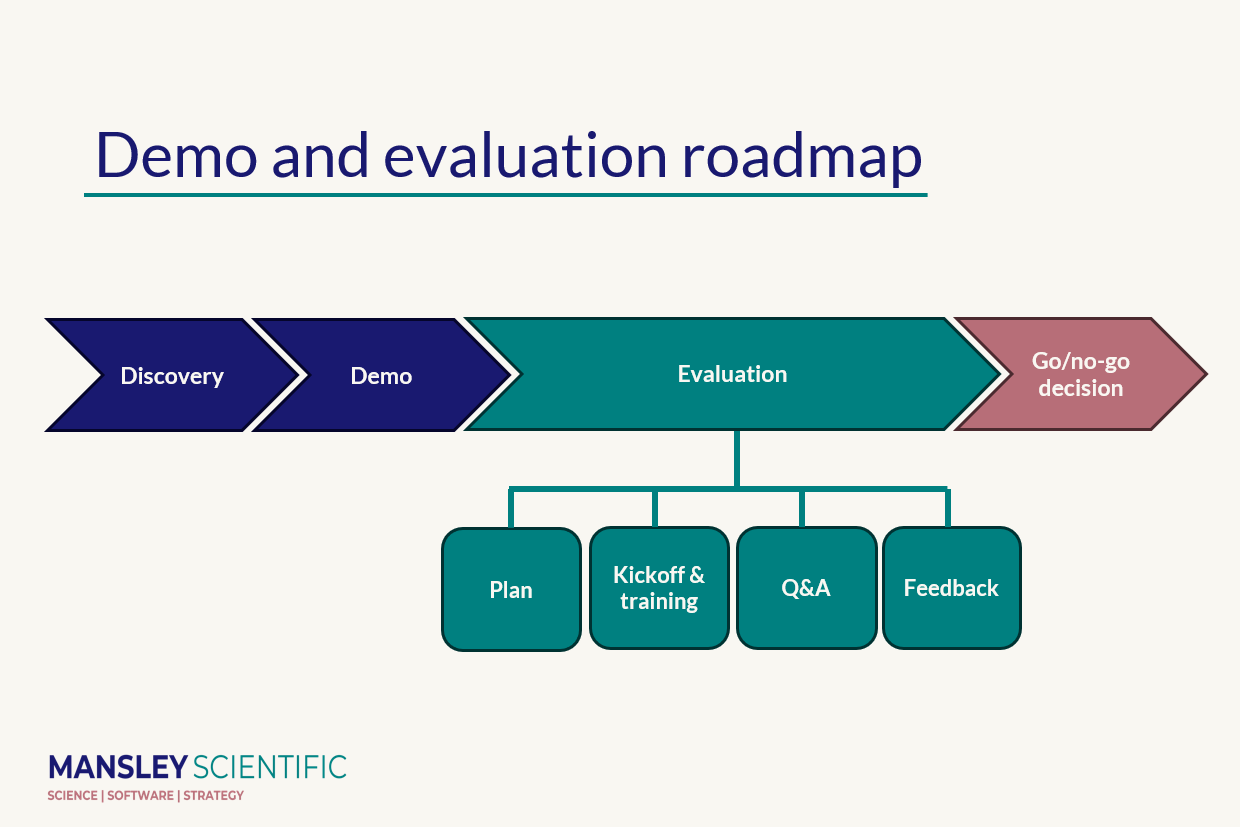
Run a tight, three-step cadence, planned and communicated in advance. As I outlined in Demo differently, setting clear expectations at the end of the demo prevents an evaluation from stalling. Don't leave an evaluation on autopilot. Hold a hands-on kick-off to orient users in the software and get the first workflow running immediately. Follow this with a mid-point working session to catch technical snags while there's still time to fix them, answer questions, and direct users toward useful functionality. Finish with a final review with both the scientists and the budget holder to measure results directly against your starting criteria and address any remaining open questions.
Structure respects the customer's time.
Some commercial teams hesitate to put boundaries around evaluations because they worry it feels pushy with scientific buyers. The opposite is true. Scientists are busy, and company priorities move fast. Keeping the evaluation period short, addressing the data bottleneck, and defining the decision criteria before the evaluation starts protects both sides from wasted time. It also shows the customer what it will be like to work with you: focused, practical, and built around helping them get real answers.